
Recounting all of my songwriting classes at the Elder Conservatorium
SONGWRITING 1B: SEMESTER 2
Class 1: Prosody, Metre and Lyric Modes.
During this session, our group focused on prosody in arrangement. With “prosody” being the measure of how cohesive/ effective an arrangement or song is – depending on how all elements of the song work together. While there are several elements that contribute to a song’s prosody, this session of songwriting emphasized the importance of lyric writing.
With Grayson explaining how metre and metrical “feet” can alter an arrangement, we were asked to give a few examples of how stressed syllables can affect the evocation of a lyric. Unstable metrical patterns tend to evoke harsher, more hostile feelings, while stable patterns are more suitable for more jovial or heartfelt songs.
“That time of year in which we start again”
Working with Tilly and Ruby, we wrote a song called “Eryn Stopped”.
Eryn Stopped
Fmaj7
Just by simply using the phrase, “I don’t want to break up again,” we learned how varying the emphasis on a different word can change the delivery, and in turn, the intent. This then led us into a discussion about iambic and anapaestic metre and how stressing syllables in a consistent pattern is inherently musical.
Eryn Stopped
By my door.
Does she know
What she’s looking for?
C
I know
(Echoes)
Fmaj7
Running late
Is it fate?
It won’t be long.
I won’t hesitate.
C
I know
Fmaj7
Metro’s slow
Nowhere to go
So, I’ll wait for you
To come home.
C
I know
Am
Even though
Em
On the car ride home
Fmaj7
I’m driving slow,
With nowhere to go
Nowhere to go.
Am
Into the night
Em
I see bright lights
F
Into the night
D
I see bright lights.

Class 2: Harmony Part 1.
In our second workshop this semester, our group worked on harmony and how the elements around a melody can change the feeling/interest of a piece. Focusing on four main harmonic techniques:
- Line progressions
- Pedal/ Ostinato
- Chord Variations
- Guitar Shapes
We were tasked to write a song in the key of C or C minor utilising these four in different sections of the song. Working with Ruby, we wrote this arrangement:
Cm Cm/Bb
Cold wind blows
Cm/Ab
Silver rain drops falling fast
Cm Cm/Bb
I don’t know where you are
C
I hope this feeling won’t last.
Fmaj7 Bbadd11
Cm Cm/Bb
Trees cast shadows on the pavement
Cm/Ab
I wish you were here
We could chase them
Stepping lightly on this tightrope
I hope this won’t be long
C
I hope this feeling won’t last
Fmaj7 Bbadd11
Alfie and Robin
(refrain)
This session was fast-tracked and made easy for me as an accompanist using my capo on fret 3 of the guitar. Being able to use open an Am chord shape helped me in writing a simple descending bass line (C, Bb, Ab) along with the corresponding chord shape (Cm). The arrangement was lifted by using the non-diatonic C major chord. It gave the driving chord pattern a resolution.
Class 3: Lyrics Pt 2.
Week 3 of this semester elaborated on the work from week 1 in lyric writing. In this session, we discussed idea development and how impactful lyrics are full of metaphors, references and imagery. Specifically, Grayson explained how names, time, places and colours can bolster a straightforward lyric into one a listener can interpret. Through this we, as a class, thought of some key words to develop. These were:
- Lavender (colour)
- Heaven (place)
- Statue (object)
- Derek (name)
- Train (object)
- Saturday night (time)
- Mum’s Basement (place)
- March 12th (time)
In this session, I worked with Ruby and Miguel. As Miguel is an extremely proficient pianist, he suggested to use a classic jazz line-cliché pattern in C major. The colourful chord progression allowed room for some lovely descending melody lines. The lyrics we came up with were:
When Saturday night
Turned to Sunday morning
Caught in a haze
And I’m already falling.
Lavender, scent of her hair
Now she’s got me
That much is clear
That day.
Well, it lingers on my mind.
It was March,
March the 12th
If I remember it right.
She lives
Rent free
In my mind
In my mind
These lyrics paint a picture for the listener. It sets a scene where the performer describes the atmosphere where they are reminiscing over a love interest using time and place (Saturday night, Sunday morning, March 12th) and colour (lavender) as a sensory element.

Class 4: Harmony Pt. 2 – Harmonic Modulation
During this week of our song writing sessions, we talked about the concept of harmonic modulation. Harmonic modulation is essentially moving away from a songs key centre into a different one (higher, lower, major, minor). Harmonic modulation can be used to lift an arrangement or bring a different colour to a progression to increase the listeners interest in a song. We learned about the common ways musicians effectively use this concept, these were:
- Relative Minor/ Major
- Transition or pivot chords
- Parallel Major/ Minor
- Changing chord function
Working with Ruby, we came up with a fast-moving melody and lyrics featuring some references to location and time (New York, Barcelona, Main Street, 1987). The chord progression features two secondary dominants (changing chord function) that deviate from the diatonic (C major). These were the B7 into the Em chord and the E7 into Am. The melody featured a lot of triadic movement to accommodate the loaded chord progression. In my own version I added some ascending chromatic runs over the modulating harmony.
Chords:
C B7 Em
A7 Dm C#b5 E7
Am9
Dm7
Am7
Gm7
Lyrics:
80’s fever!
Main street baby
1987
Seems like yesterday
You pulled away from me
On the dance floor
Distant memory
Drive me crazy
Just can’t overcome you.
Seems like yesterday
Swear I saw your face
Down in New York
Or Barcelona
Nice to know ya
Pull me closer
I’ll see you later in Spain!
Class 5: Motive Development
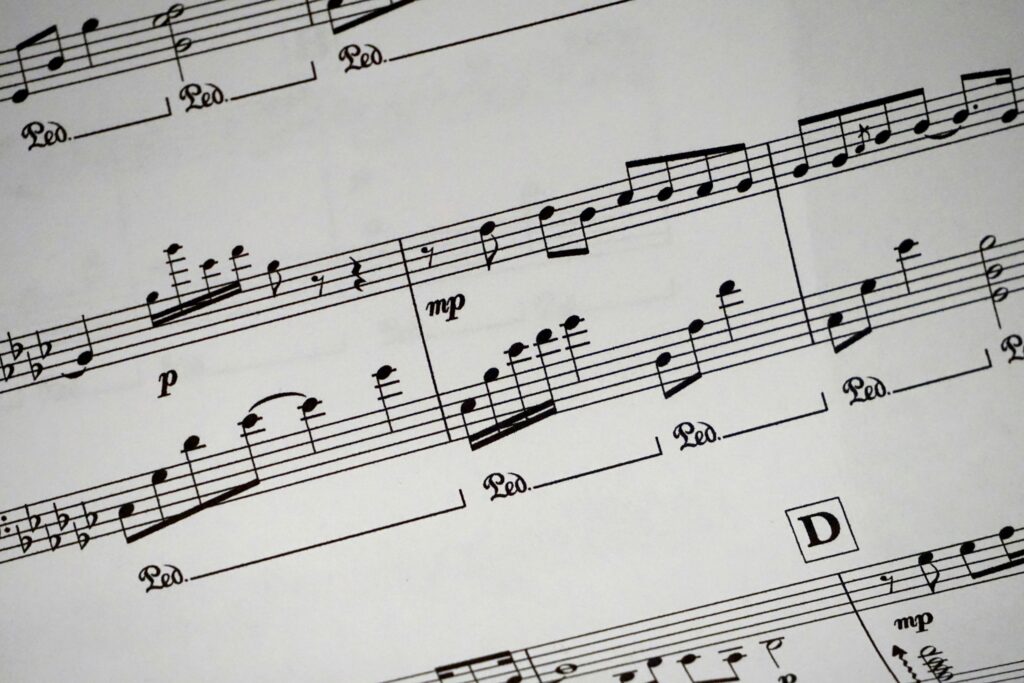
Motive development was not a class we did in person but one I explored in my own time. Like in the literary sense, a musical motif is a recurring musical pattern that appears throughout an arrangement or builds a section of it. One of my favourite songs is, “I Wish I Didn’t Miss You” by Angie Stone which samples the intro of “Back Stabbers” by the O’Jays. The rising bassline is a musical motif that makes up the basis of the whole song and heavily inspired my process with this song.
My personal style of songwriting often includes an ostinato pattern that makes up the foundation of a song. Sitting at my piano, I enjoyed the sound of an arpeggiated Eb motif over a Cm chord (iv) and Fm (iii). In my production, I recorded the piano with a metronome playing in the background. I liked that the only percussive element came from this and with the added bassline, I cut up the piano to fit into the groove. The harmonies are repeatedly saying “to” which eventually makes sense as the refrain resolves with, “and she knows you love it (to)”.
Celia loves your company
Knows just what it takes to come off
So well-versed in society.
She’s the lock on the door,
You’re a fly on the wall.
Takes as much as she can carry
Gives as good as she gets, and she’s gone.
Knows she’ll never have to worry
‘Cause she’s living for it
And she knows you love it
To
To
To
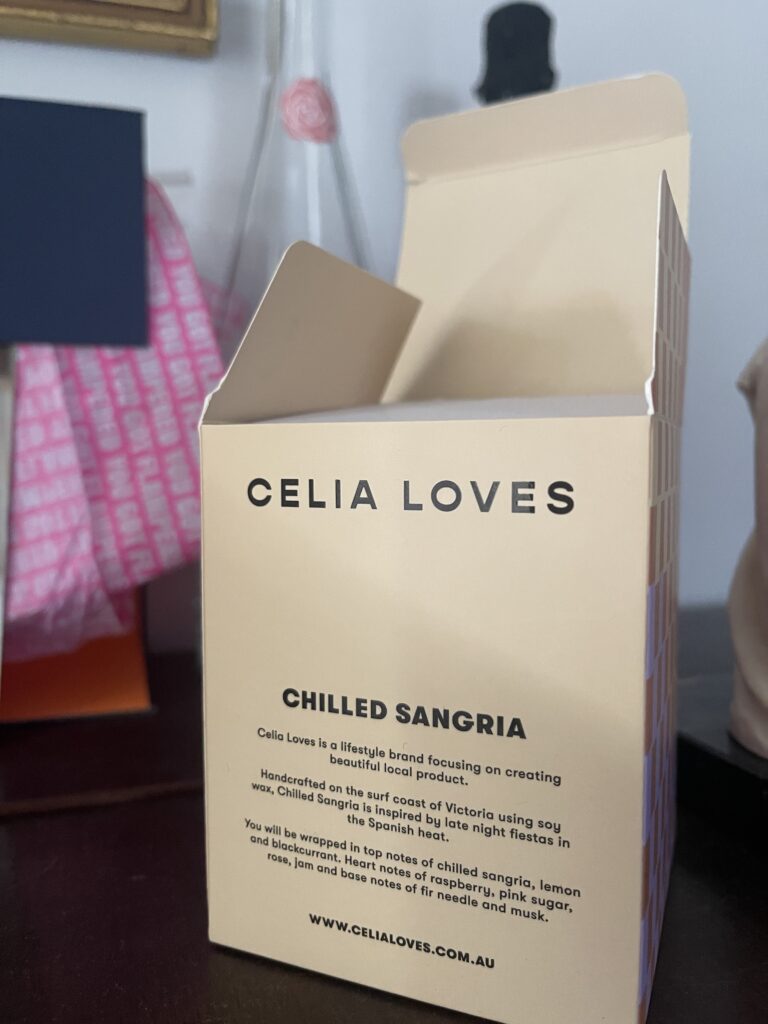
The lyrics were entirely improvised. There was a gifted candle box sitting on top of my piano and when I looked up, the brand name, “Celia Loves” really stuck out to me – I thought it was very strange. Interpreting the lyrics after having written them, it seems I was inspired by an anecdote of a codependent friendship a friend of mine relayed to me the night before. Narcissistic people isolate, much like Celia being a lock on the door.
Class 6: Minor Melodies, Melodic Momentum Melisma
During this week, all the members of the songwriting class got sorted into their semester bands. We were all very excited to find out who we were going to perform with at the end of the semester. In this session, we talked about the different ways to use minor melodies in songwriting. Focusing on four different minor scales:
- Natural Minor/ Aeolian
- Dorian Mode
- Harmonic Minor
- Melodic Minor
The intervals of each scale provided different colour and tone to a piece of music. Paying attention to where each unstable interval leads into a stable one can elevate a piece of music. In our band group, we chose to build our song after a common minor chord progression: i (Cm), iv (Fm), VII (Bb), VI (Ab).
You say,
You wish you were born in 1972
The park that I first met you
It’s so cliché
The castle was crumbling
The sky started falling through
When I look at you
I don’t want to do this in vain
I’ve practised the words I wanted to say
I’ve already taken that train
I’ve walked down that road
I’ve stood in the rain
Skip to chapter 58
Don’t have to explain
I’ll procrastinate
I’ll procrastinate
I’ll procrastinate
Within the song, there is one instance of a Dominant V (G) chord, which is derived from the raised 7th in the harmonic minor scale. This strong pull is what leads the verse into the chorus section. The chorus section also exhibits some phrasal acceleration that adds complexity to the arrangement.
Class 7: Arranging
This week of songwriting was dedicated arrangements of songs and compositions. In the workshop we listened to many different versions of well-known songs and discussed their strengths, weaknesses and overall emotional evocation. Moving away from this, our class discussed how modern popular music is majorly a recreation of melodies and chords that have been used many times over. The appeal of modern music is that there are ways to rearrange and rework melodic ideas to make them sound entirely new. This discussion reminded me of New Order’s “Blue Monday”. The song was a global hit that used a very distinctive (and borrowed) drum part. The introductory kick is a reworking of Donna Summer’s, “Our Love”.
It was just Ruby and I working together in this session. We wrote this short song from the brainstormed words. I feel that the hook sections have a lot of potential to be fleshed out and arranged, they sit nicely above the piano chords.
In the backseat of my mind
All the faces I couldn’t find
Looking down that rabbit hole
Excitement I can’t deny
I’m falling
I’m falling
I’m falling through
Red skies
I’m dreaming
I’m dreaming
I’m dreaming of
Cherry blossom nights.
Class 8: Arrangements
On the first week back of the semester, I was absent from the songwriting tutorial. Having read the set module for the week, the class focused on the arrangements of our intended songs for the recital. For this week’s entry, I have my demo for my song “non-issue”. Working through this song was a bit more difficult than I initially expected. Having written the hook first it seemed difficult to work the verses around it. I struggle to let words breathe in my arrangements, I enjoy fast moving rhythms and often get carried away. Because the pre chorus sections are very wordy I made sure to slow the arrangement right down – about 85 bpm. The demo features some finger-picked guitar, vocals and an electric piano. In my opinion the electric piano drives the harmonic accompaniment, I wrote it to in the high-end frequencies on top of the guitar, and it does a lot of the heavy lifting to create interest. Overall, I’m happy with the result.
Class 9: Non-Diatonic Chord Progressions
In this week of songwriting, our class focused on non-diatonic chord progressions. Chord progressions that function outside of their key centres are usually borrowed from keys that have a relationship with the original key e.g. borrowing from the parallel minor. We also touched on the concept of “plagal” stacking. This is finding the chords between one diatonic chord to another using the perfect 4ths below the last chord until the initial chord is reached. This session focused on using these non-diatonic chord concepts in practice.
The song I have submitted for this entry is not one I did in class. This is a song I wrote specifically with multiple key changes in mind. Essentially chromatically moving down the neck of the guitar to create an ever-changing melodic pattern. I feel that it suits the style and content of the song quite well as the narrator is essentially relishing in their instability of character.
Dm Dbmaj7 Cm Bmaj7 Dbm9 Ebmb5 Emaj7 Ebm7 Dbm7
You can be resentful if you like
It’s not my fault I’m so good at
Repeating past behaviours
Once or twice
It’s not so much of a vice
If I just take it in stride
You’re confusing favours from the past
With ones, I never promised you
And now you’re feeling cheated of your chance
To say
That, “I was always feeling this way”
But I’d save my breath
‘Cause I find your rambling boring
‘Cause I know that once I’ve left my
Witching hour’s impending…
Sooner, perhaps or later
You might find
That the image that you’ve made of me
Exists only in the limits of your mind
She’s much too idealised
And she slips the wool right over your eyes.
So kindly, if you think I’ve been mistaken
I’ll ask to look inside yourself
To see what it is to make you become so taken
Against reason
Cause it’s all my fault
And never just even.
Class 10: Melody Pt. 3 Secondary Melodies
For the last class of this year, Grayson asked us to showcase our original songs that we felt represented us the most authentically as artists. For this class, I decided to play my song, “Miss You”, a song dedicated to home. The song is about the time I spent in the Eyre Peninsula straight out of high school. Beginning university right after graduating in 2020 proved not to be the best idea for me. As an alternative, I leapt into rural full-time work. I missed everything about home, but I knew I had to do it for my well-being. I believe I became all the better for it.
Lyrics:
To only say I miss you
Would hardly articulate
A fraction of the feeling that I get when my heart aches without you
And to only say I love you
Falls just short of a longer phrase
I could only string together
If I had better words to say about you
Cause the sun rises and falls with you
So taken by the things you do.
But you know I have to be here
Not only for my own good, for yours.
And you know I have to stay here
Just for a little while so I can find what I’ve been searching for.
So I’ll take it by the day
And I’ll take it by the dollar
And I miss you every second and I miss you every hour without you.
Cause the sun rises and falls with you
So taken by the things you do.
I know that I’ve hurt you more than time and time again.
And I know that you hate when I’m an on again off again friend.
I know you’ll wait till I’ve gone and come back again.
But you know I’m trying my best not to fall off the deep end.
And so to only say I need you
Would grossly understate
The feelings that I have
When I’m so few and far away from you.
Cause the sun rises and falls with you
So taken by the things you do.
But you know I have to be here
Not only for my own good, for yours.
And you know I have to stay here
Just for a little while so I can find what I’ve been searching for.
To only say that i miss you
Would be to say I don’t care
And to only say that I love you
Would be to say I was already there
And to only say that I need you
Would be to say that I’m fine
‘Cause to find the words to say would hardly be the ones to neither write.
‘Cause the sun rises and falls with you
And darling I miss you.
Unfortunately, I do not have a solid recording of this song, and as this module is on secondary melodies, I have placed a recording of me building the counter melody line on my song, “nonissue”. In my creative portfolio, the song features a lot of vocal stacking, using the counter melody vocals as a key part of the arrangement.
Citations:
AngieStoneVEVO. “Angie Stone – Wish I Didn’t Miss You” YouTube, uploaded by AngieStoneVEVO, 25 October 2009, https://www.youtube.com/watch?v=9PWz-NubVpM.
“New Order – Blue Monday” YouTube, uploaded by jrrr90, 2 February 2010, https://www.youtube.com/watch?v=FYH8DsU2WCk.
Donna Summer. “Our Love” YouTube, uploaded by Donna Summer, 8 August 2018, https://www.youtube.com/watch?v=NCcQDxSmlvY.
SONGWRITING 2A: SEMESTER 1
Class 1: Expanding your instrumental palette
Led by Luke, the first session of songwriting this semester focused on the importance of timbre in an arrangement. A large portion of this semester’s assessment will be for us to create a string section arrangement for one of our songs. This is an exciting prospect for me as an artist as I am delving wholeheartedly into my R&B project OPULENCE with my best friends/ bandmates, Isaac Hayward and Lily Hogben. Strings is an essential element in a lot of R&B, Hip-Hop and Soul adjacent music and can be an integral part of elevating the movement of a song. Luke outlined in the tutorial how increasing the variety of instruments and timbre in an arrangement can fill the “big picture” of a song by meeting all the different frequencies within the sonic space of a song.

One of my favourite compositions is “Stand” by Yebba from her debut album Dawn. The subtle strings during the entirety of the track lift the arrangement and highlights the intricate vocal harmonies and counter melodies. Another great example of string usage in R&B is Victoria Monet’s “Hollywood Feat. Earth, Wind and Fire”.
IMPROV WEEK 1:
During this semester, our songwriting will be developed by six weeks of improvisation sessions with Derek Pascoe. After the initial five weeks of improvisation, we must cover one of our classmates’ songs using the skills taught to us. In the first session, we used one of Amelia’s songs as a vessel to explore different genres of music. Amelia’s writing style is a great combination of country, pop and pop-punk – I find her work reminds me of Olivia Rodrigo. With her song, we explored the conventions of punk, bossa nova and jazz. Her song was easily manipulated to fit these different genres. This gave me some insight into good songwriting and how a melody paired with well-placed harmonic rhythm can easily traverse many pop genres.
Class 2: Introduction to Writing for Strings
During this week, our tutorial focused on string arrangements. In the session we considered what a string quartet is and where every instrument sits in terms of harmonic range. When writing for a quartet it is important to consider the sonic spectrum the four string instruments can reach, and how they would complement an arrangement or take away from it. A string quartet can be an incredible addition to a song as there are a variety of techniques that string players use to manipulate the timbre of the instrument. These can include the way a note is bowed, plucked and even struck on the instrument. We also discussed how quartet players, especially experienced ones, balance themselves by constantly listening to each other. Well-written string arrangements often utilise communication between the cello and viola so a quartet balancing their mix and volume will truly bring out the best in an arrangement.
IMPROV WEEK 2:
In our improvisation session, we used one of Ben’s songs to rearrange. His song, “under the lights” is a beautiful, spacey, indie-rock arrangement that highlights his skilful melody and lyric writing. Again, this session saw a lot of genre-bending, but also elemental manipulation. In this case, the country rendition of Ben’s song used a slide guitar part. By changing the timbre of the already existing guitar lines, the song changed completely and had a very different effect on the audience. I have personally never used this kind of texture in my music before, so it was interesting to hear how the song was effected by this.
Class 3: Arranging for Strings (Case Studies)
This tutorial saw our class analyse string arrangements used in well-known pop songs to determine how they achieve forward momentum. In this session, we analysed “Thunderstruck” by ACDC, “Poker Face” by Lady Gaga and “Dance, Dance” by Fall Out Boy. The main takeaway from this session for me, was that a lot of pop songs are reliant on combination of repeating hook lines combined with meticulously placed textures. This especially evident in “Poker Face” as the synth lines are quite simple in but effective because of their effects; they really work well in combination with the melody. This has given me the insight that in pop music the production is just as important as the songwriting.
IMPROV WEEK 3:
This week in our improv session, Derek proposed we cover a pop “standard”. Inspired by his own jazz background, Derek explained to us that in the process of becoming a proficient jazz player and artist, one must cover jazz “standards” in the style of renowned jazz players. In this session our small group landed on doing a cover of “Hopelessly Devoted to You” performed by Olivia Newton John in Grease. This song is a musical theatre classic but still uses pop conventions as a ballad. I was picked to sing for this exercise, and it definitely brought back some of my theatre memories. We tried changing the time signature from 6/8, to regular 4/4 and it was quite a confronting challenge; the rhythm aspect of music theory is not my strong point. Overall, I believe it broadened options for cover pathways I can potentially take when I get to my cover.
Class 4: Melodic Writing for Strings and Approaching Your Arrangement
During this week of songwriting, I was absent from both the tutorial and improvisational session. Looking through the module, this week’s session delved deeper into the process of creating a successful string arrangement. The module focused on melody writing for the strings and which instrument of the quartet would do the best job at highlighting the melody of a song. For the string writing task, I am certain that I will be utilising the string recording for one of OPULENCE’s songs, “MOVIEGUY”. As this song uses an electric guitar as one of the main harmonic instruments, I need to make sure the strings don’t overpower but compliment the guitar line.
I work in a primary school as a singing tutor hired by my high school music teacher. During this week, I decided asked for his insight on string writing as well. One of the main elements of classical string writing that he stressed to me was the use of viola to progress the arrangement. This coincides with information on module that states the viola has a singer-like quality and its tenor range cuts through the mix.
IMPROV WEEK 4:
As I was absent from the improv session this week, I will talk about beginning the writing process of my performance song for this semester, “Curtains Closed”. I often find my songwriting is best when I begin with the hook and chorus rather than the verses. This is what happened with the beginning of this song. Through writing the lyrics and melody of the song, I found that the post-chorus was very strong and had great potential to be a big moment in the song. Here is a TikTok I made just after I wrote it:
Class 5: Considerations for Brass and Wind Instruments in Arranging
This week, our tutorial focused on brass and wind instrument arrangements in pop music – notably “Crazy in Love” by Beyoncé and “Livin La Vida Loca” by Ricky Martin. In this session, we learned about the ranges of each brass section instrument and their function in a band – similar to the sessions we dedicated to string arrangements. A particular piece of information that I found interesting was the focus on Cuban rhythms in “Liva La Vida Loca”. I really enjoy the brass/ woodwind element of this song, and I think that utilising a brass/ woodwind section in traditional and culturally significant way makes this song really special. Interestingly, “Livin La Vida Loca” was the first #1 US single to be recorded entirely on a DAW; previous big hits had been recorded either entirely analogue or a combination of digital and analogue recording.
In the session we also briefly talked about Beyoncé and her live performances. The brass and woodwind section in “Crazy in Love” is a sample. In the video we watched, there were live performers playing in the brass section. Luke explained to us that while the performers gave the impression they were playing live, it is most likely not the case as the sample remains the same. All this discourse reminded me of Beyoncé’s performance of “Déjà Vu” at the 2006 BET Music Awards. In this clip, I believe Beyoncé forgets she’s human and it’s just amazing to watch.
IMPROV WEEK 5:
Unfortunately, this week I was also absent from our improv session, however I did finish my song “Curtains Closed”. You can listen to my acoustic demo here:
Class 6: Considerations for Orchestra
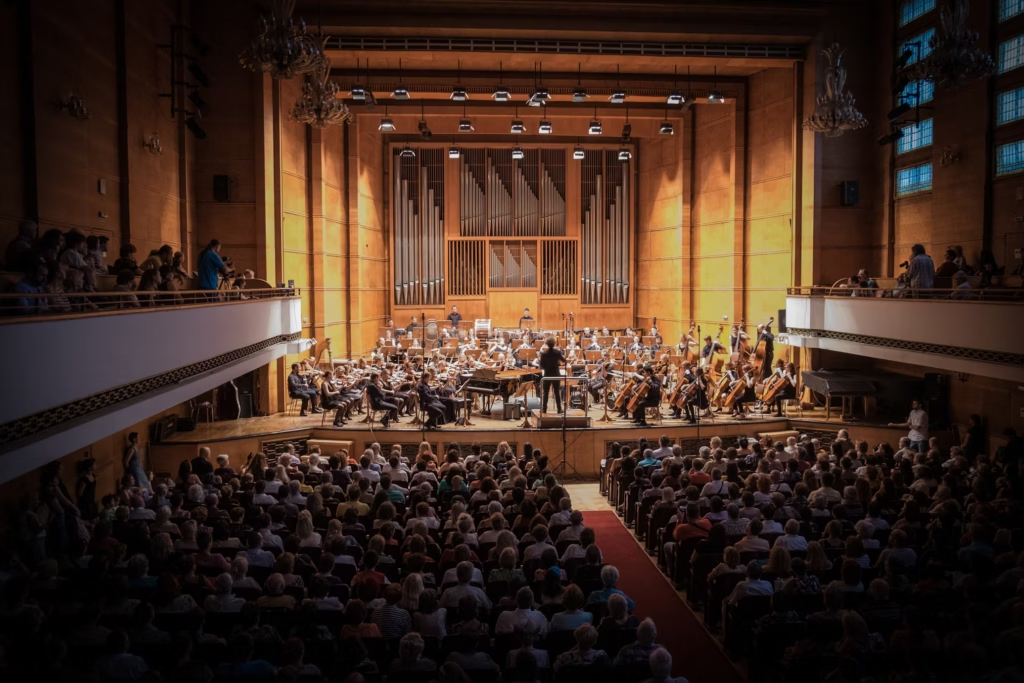
The week’s tutorial was a session fully dedicated to orchestral arranging. Luke went through all the conventions of a full orchestra, from placement of instruments to their different ranges. The main takeaway for me from this tutorial was the importance instrument placement. From the beginning of this semester, Luke has outlined the different ways an arrangement can fill the sonic “big picture” by filling up the entire timbral spectrum. In an orchestral setting, instrument placement is incredibly important to the ebbs and flows of a full orchestral arrangement. The chords can be incredibly lush so the natural panning by placement of each instrument is integral to the effect of a performance.
IMPROV WEEK 6:
During the sessions of improvisation, I learned that to successfully cover a song and create an alternative version of it, I needed to have a clear understanding and vision of genre and influence.
My partner for this task was my classmate, Roxy whom I had no experience working with before. Her song, “Purgatory” was the song she chose to send me and that I have now found accurately represents her as an artist.
Her music is influenced heavily by 80s ballads and glam rock, a genre I have no experience in writing. This proved to be in my favour however, as I had a lot of room to manipulate the song to a fit a more contemporary production.
Upon hearing the song, I found that the melody and lyrics were sparse and flowed easily through the guitar. With the demo she sent me, I found that the arpeggiated guitar was perfect to sample from. Through singing the song a few times over the looped guitar pattern, I thought I could give the sample a hip-hop inspired drum pattern to take it into R&B territory. It kind of had an alternative R&B feel once I did this, so I decided to take the song into an early Rihanna direction, heavily inspired by her songs, “Russian Roulette” and “Rehab”.
Her album “Good Girl Gone Bad” has many tracks produced by Jay-Z that have a bit of a cursed feel; especially “Disturbia” and “Rehab”. With this album in mind, I set to work on an alternative R&B version of “Purgatory’. I did this by adding strings and modulated piano to add a bit of atmosphere to the production.
The melody in the verse sections I didn’t change much as I felt that they worked with the genre. However, I did decide to change the chorus melody to add a hook line. Repeating the last word of each line, I created an “Umbrella” inspired motif with syncopated vowel sound.
Overall, with a bit more work and vocal tracks, I feel that this song would be a cool addition to Rihanna’s “Good Girl Gone Bad”.
Class 7: Reflecting on Creative Practice
BAND LOG 1:
Now that our class is back from semester break, it is time for all of us to prepare for our band recitals. My band this semester consisted of members Tyson, Hugo, Roxy and Tom. I was super excited to work with these guys as I have never worked with them before due to me starting my university journey again in 2024 semester 2. Our first rehearsal was successful; we all showed each other our songs/ ideas for performance pieces and discussed rehearsal schedule. As I had a completed song, we decided to have a go at my arrangement to begin with. This recording is an extremely rough first run-though of the song. The two main issues here were the balance of volume and the pace of the song; this is a common occurrence I think when rock artists attempt R&B and vice versa. Despite the balance issues, I was happy with where the song was headed.
Class 8: Approaching Vocals: Arranging / Production and Gang Vocals
BAND LOG 2:
Class 9: The impact of arrangement, performance and production on the meaning of songs
BAND LOG 3:
Class 10: String Arrangement
BAND LOG 4:
Citations:
“Beyoncé (feat Jay Z) – Deja vu live at BET 2006” YouTube, uploaded by beybeingqueen, 3 July 2024, https://www.youtube.com/watch?v=hnIXdXWuzkU
OPULENCE. “OPULENCE – Little Heartbreak OFFICIAL MUSIC VIDEO” YouTube, uploaded by OPULENCE, 12 June 2025, https://www.youtube.com/watch?v=QUS5Q7tDk00
Cotugno, Nicoletta [@nicolettacotugnomusic]. “friday afternoon writing.” TikTok, uploaded by @nicolettacotugnomusic 21 April 2025, https://www.tiktok.com/@nicolettacotugnomusic/video/7484143611160939784
Rihanna. “Rihanna – Russian Roulette” YouTube, uploaded by Rihanna, 5 December 2009, https://www.youtube.com/watch?v=ZQ2nCGawrSY
Victoria Monét. “Victoria Monét – Hollywood (feat. Earth, Wind, & Fire and Hazel Monét) (Visualizer)” YouTube, uploaded by Victoria Monét, 25 August 2023, https://www.youtube.com/watch?v=zFuC9JmR-cY
Yebba. “Yebba – Stand (Audio)” YouTube, uploaded by Yebba, 10 September 2021, https://www.youtube.com/watch?v=whxeWUN7XVI